It is impossible not to recognize a superhuman force when you encounter Inferno—a band that
channels a profound, high-level awareness in their music. The Czech band demonstrated
this especially well on their latest full-length, Omniabsence Filled by His Greatness,
delivering a serious, dark, ritualistic assault tailored for fans of black metal.
With a brand new full-length on the horizon and European shows continuing throughout 2016,
vocalist Tomas "Adramelech" kindly answered our questions in this exclusive interview.
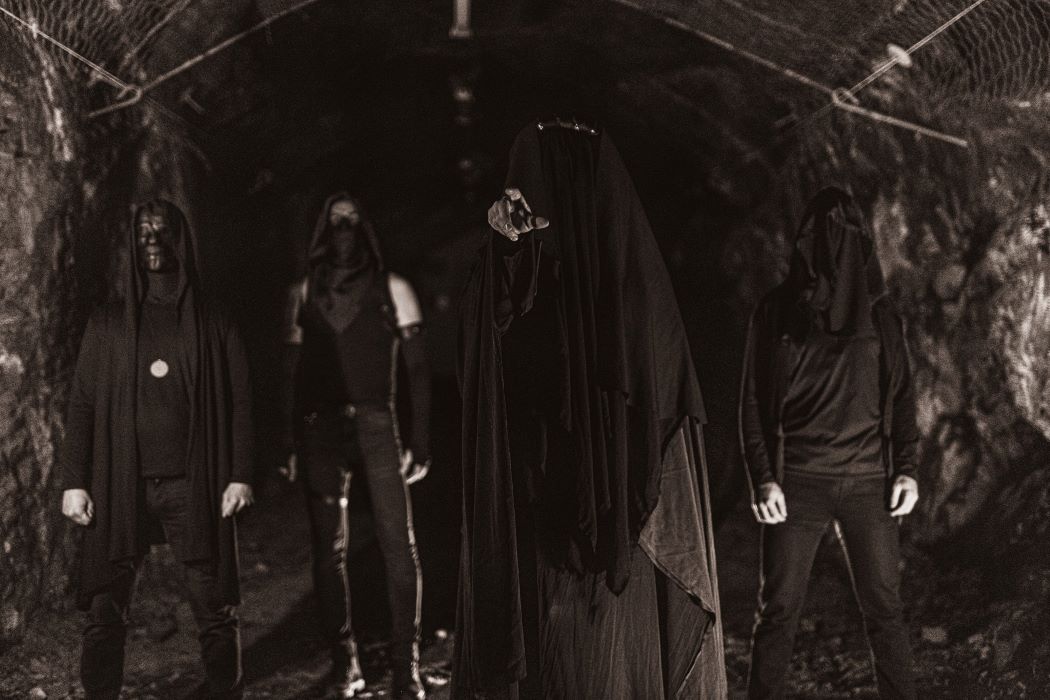
MORBIDZINE: Infernal greetings, Tomas! Thanks for taking the time for us. What kind of bewitchment, anti-human elements, and darkness should we expect from the new album? Will it continue the sound of Omniabsence Filled by His Greatness?
TOMAS: Salve Satanas,
The new album Gnosis Kardias (Of Transcension and Involution) will continue the path and vision of the previous album Omniabsence Filled by His Greatness, so one can expect compositionally complex and dense, personal music. The album is shaped by our personal approach to various doctrines, ideas coming from the innermost selves, our own spiritual practice and experiences. The album is intended mainly for those who are capable and willing to grasp its substance and potential. We have always tried to portray our own inner movements, our true wills and now we also step over the limitations of the past. We wish to know and see beyond the horizon.
MORBIDZINE: For example, I listened to albums such as Black Devotion, Uctivani Temne Zurivosti, and the latest one. The band’s direction remains consistent, but I hear a significant sound evolution on the latest release. Would you agree?
TOMAS: Yes, that is true. Personally, I think that Black Devotion and the period around that album was a milestone marking a new era of INFERNO. Around that time, we moved forward and gained a certain distinctiveness now evident in the latest works. It ignited a spark inside us that pushes toward our personal notion of artistic “perfection.” The main impulse behind the change was the departure of the past guitarist Azazel, who was also the main composer. This role then passed to Ska-Gul. Our previous routines and principles were re-evaluated, and everything became clearer and freer. Our minds started to work, certain vibrations were strongly felt and evoked, and we found good chemistry. We just followed these incentives and knew immediately that the music of INFERNO would never be the same.
MORBIDZINE: Honestly, Omniabsence Filled by His Greatness was truly on another level in the black metal scene in recent years. I’m curious—how long did it take to record this frenzy? For example, how many guitar layers did you use?
TOMAS: Thank you for your words. It took us approximately two years to prepare and create Omniabsence.... It was important to find a clear source within us that would fuel writing music and lyrics. That was and still is the primary impulse to create the new album. We never create something new if there is not a strong need to unleash inner and outer feelings mirroring our world. But it is a long and demanding process to create something truly personal, as we are not capable of composing on command.
The recording itself is divided into three 7-day sessions. During the first week, we record drums, rhythm guitars, and bass; after about half a year, we return to record vocals and guitar arrangements. This long break is very important for creation because then we are capable of completing the compactness of the music and searching other recesses of our souls and compositions. Mixing and mastering come last, obviously.
The guitar arrangements are crucial, and in some places, there are up to 7 layers of guitars (not including bass and rhythm guitars).
MORBIDZINE: For Omniabsence Filled by His Greatness, the track names give a general idea, but since we don’t understand Czech, we want to know the overall concept. The unusual cover art suggests "The Teaching of the Kabbalah" might be a key theme—is that correct?
TOMAS: Looking back, I don’t think Omniabsence... is conceptually as coherent or comprehensive as, for example, the lyrical side of the upcoming Gnosis Kardias. However, the last album’s art relates to its themes, and the next album’s art relates to its concept as well. There is an effort to reach the zenith of one’s experience and what lies beyond—to grasp the freedom that lures seekers. We also portray the individual’s struggle in the natural link between man and universe. We do not rely exclusively on a single tradition, mysticism, or practice. The album voices a soul wishing to be free. But in the lyrics, there is also a sense of universal negativism, even nihilism, and cosmic dread, which we aim to transubstantiate for our own use in search of true freedom, far from this world, beyond death. This leads me to think that, in the end, we create more evil and thus fulfill one of existence’s meanings—to traverse through the second sun into the reverse world of the Sephirotic tree (to use Kabbalistic terms) toward the fullness of chaos.
MORBIDZINE: You’ll play many places in 2016, including Mexico, Europe, and the Balkans. Since Inferno’s shows are ritualistic and specific, have you faced difficulties finding suitable venues?
TOMAS: Yes, several great concerts are planned in Europe and beyond this year. It’s always good to have a stage of suitable size, allowing space for all the props that enhance the visual, aesthetic, and ceremonial presentation of the band. I think I can speak for all bands when I say a big backstage is also appreciated, allowing a reasonable arrangement of instruments and baggage so no one rummages through heaps of stuff to find something. Order is a must. But suitable space isn’t always available, which makes things more difficult—but that’s understandable, and we don’t worry much if playing smaller venues. Direct contact with the audience is rewarding and fulfilling enough.
MORBIDZINE: What are the main influences on your lyrics? Were there any books on occultism?
TOMAS: While the literary influences shaping Omniabsence... lyrics were mostly limited to classic occult lore, the next album expanded its scope significantly. The greatest influence did not lie in words or information you can buy or find online. Some experiences profoundly transformed us, solidifying or shattering old notions. Some were “randomly” received, others evoked by specific means. For us, it’s impossible to describe these events in words—they’re too personal to publish in a booklet. So literary influences helped give form to those feelings and visions. We avoided an academic approach or dense esoteric symbolism. Thus, in Gnosis Kardias lyrics, you’ll find references to prose, poetry, and many scientific theories. Everything is interconnected, and our hermetic approach to ancient and modern, Eastern and Western, remains strong. I believe when one hears Gnosis Kardias, the sounds, words, and visuals will create something abstract yet powerful, gnawing at consciousness until listeners experience the world’s unsubstantiality—maybe, or maybe not!
MORBIDZINE: Do you believe satanism can be fully understood in human form? What do you think happens after death? Is humanity a slave imprisoned in an infinite cycle? What lies beyond the universe? Please share your thoughts.
TOMAS: There are many ways to approach such topics. First, find your own path and answer these questions yourself. Pages have been written on these topics, with many opinions—scientific and lay—as well as lies and half-truths from those twisting facts for their own needs. Many turn to religions for answers about death and the afterlife. World religions, in their forms and streams, idealize yet negate death by promising better eternal afterlife or paradise. But our reality is different. Many I know see life as a great gift, with death as a gate returning that gift, with a hazy chance of resurrection. The search for truth is more precious than truth itself. If humans truly have immortal souls and divine essence, shouldn’t they walk their own path alone toward enlightenment? If we feel the urge to understand, we should awaken these qualities within and set forth on often windy, crooked paths—being wary of those seeming straight. I believe life comes and goes in cycles; we incarnate in various vessels, times, and circumstances, moving from cause to consequence. Human life is not isolated or finite; it reflects past lives and is the nucleus of the future in existence’s spiral.
MORBIDZINE: What is the importance of De Mysteriis Dom Sathanas in black metal? What path did this album open for you? And which new albums have you listened to most recently?
TOMAS: For me, De Mysteriis Dom Sathanas is a timeless masterpiece. I’m a great fan, and it influenced my youth so much that I consider it one of the best black metal records ever.
I admire and frequently listen to bands like Katharsis (GER), Judas Iscariot, Moonblood, Deathspell Omega, Ondskapt, Acherontas, Leviathan, Svartidaudi, Sinmara.
MORBIDZINE: The black metal scene in recent years (including atmospheric and arpeggiated styles) has exploded with new bands. Do you think there are inauthentic or trend-driven situations in the scene? Sometimes, many bands seem like mere imitations.
TOMAS: I try to follow bands worth my time. Those meant to cross my path eventually do. I prefer when artistic sense meets a personal touch, with spiritual and inner potential trying to replant black metal’s rotten roots in more fertile soil. However, I am not a fan of what’s happened to the scene in recent years. The genre has become mere entertainment and a brand everyone abuses as they see fit. Just look at what happened to once-great Norwegian bands…
What was once elitist and for few now works like the pop music industry, with greedy bastards making beer brands, playing fashion shows, prostituting at commercial events, accepting vain prizes with servile smiles… It’s a dark age.
MORBIDZINE: Thanks for your time on behalf of morbidzine.com. Do you have any dark messages to send? Or any other messages?
TOMAS: We hope to see you soon at the gig in Turkey. Keep an eye out for our new album Gnosis Kardias (Of Transcension and Involution). The war has not ended yet.