You know Tygers Of Pan Tang if you want to talk NWOBHM. They have been around for 30 years and
continue strong. Their debut album, Wild Cat (1980), was a milestone in the NWOBHM movement
alongside other classic releases from that year. They later delivered masterpieces like Spellbound
and Crazy Nights. This year marks the release of their ninth studio album, Animal Instinct.
Recently, Robb Weir—founder, leader, and guitarist—answered our questions. We thank Robb and
the band’s manager Simon Morton for this great interview.
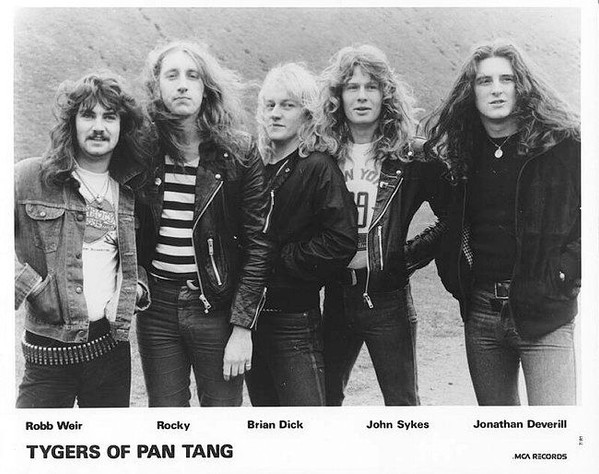
MORBIDZINE: Hello. Firstly, thank you so much for accepting this interview and spending time with us. Tygers Of Pan Tang released an EP last year featuring some re-recorded tracks. How were the critics in the UK? Especially for the new versions of “Hellbound,” “Rock ’N’ Roll Man,” and “Take It”?
ROBB WEIR: Thank you for this opportunity to talk to your readers! The reviews we have had have all been fantastic. We have been very careful when re-recording the old songs to make sure they sounded fresh and relevant but at the same time still keeping with their NWOBHM edge and rawness.
MORBIDZINE: The new album Animal Instinct will be released in the coming months and it is already talked about. It’s said to recall the band’s legendary albums like Wild Cat and Spellbound. Can you tell us about the new album?
ROBB WEIR: The new album has a ‘Classic Hard Rock’ sound to it—a sound nobody is really producing now. The songs are in the vein of our first two releases but benefit from today’s technology. Drums sound bigger, guitars fatter, bass deeper, and vocals much better. The album really rocks from start to finish. If your readers love early 80s British hard rock, it’s a must-purchase.
MORBIDZINE: Your last studio album Noises from the Cathouse was fresh, powerful, and well-produced. Although Tygers Of Pan Tang has never left its NWOBHM roots, what do you think about the band’s music from the past until today?
ROBB WEIR: Bands do change their style sometimes, maybe because of new members bringing their particular songwriting style. The balance in the band is perfect at the moment and our songwriting and musical direction is finely tuned. Noises was a slightly different direction for us, but the new album sees us return to our beginnings of raw hard rock ’n’ roll.
MORBIDZINE: Who came up with the name “Tygers Of Pan Tang”? What is the meaning behind it?
ROBB WEIR: The name came from a sci-fi book called Stormbringer by Michael Moorcock. In the book, there were the cliffs of ‘Pan Tang’ guarded by tigers in an empire. The two elements were put together and the name Tygers Of Pan Tang came about courtesy of Rocky, our original bass player.
MORBIDZINE: And the Wild Cat legend. It was a unique, characteristic album combining elements of ’70s hard rock with pure heavy metal. How were the ideas for this album created? Can you tell us about the sessions?
ROBB WEIR: When I wrote the songs for Wild Cat I had a vision of how I wanted the Tygers to sound: hard, fast, heavy, and above all exciting. Having watched the best acts around at the time—Uriah Heep, SAHB, Nazareth, Van Halen, AC/DC, Ted Nugent, Rush, ZZ Top, and many more—I was well focused on what I wanted and in which direction to go with the Tygers. Wild Cat took about a year to write; I had to make sure every song was just what I wanted. Every song brought something different to the record, like a giant jigsaw puzzle. I am very proud of that album.
MORBIDZINE: I don’t want to single out albums, but I think Wild Cat, Spellbound, and Crazy Nights were masterpieces of the NWOBHM genre. However, the band’s mission has never been fame. How do you see the band’s profile?
ROBB WEIR: I think every band’s underlying mission is to become famous and achieve great success. The first three albums were hard rock, but the fourth was mostly written by outside songwriters and was a much softer AOR American sound, which MCA wanted us to have. They felt we should ‘crossover’ more and have a wider appeal to sell more albums and crack America like Def Leppard did. This did not agree with us at the time, and although the album has an excellent sound, it is a little too polished, a little too nice, if you know what I mean. The hard edge of the Tygers is missing. So we gave up any chance of fame and fortune due to musical integrity.
MORBIDZINE: Spellbound was one of the hardest albums of the band. While it was a heavy metal album, it also contained some speed metal elements. What are your thoughts about the musical style of this album?
ROBB WEIR: Spellbound goes from ‘The Story So Far’ to ‘Gangland’—medium-paced rockers to out-and-out rockers. The whole album has fantastic riffs just waiting to thrill you. I am also very proud of that album, and I know John is too because his contribution was tremendous—a fantastic guitarist. I still think it sounds great today if you compare it to modern rock of the same genre. Live we play nine songs from Wild Cat and Spellbound because that is what the fans want to hear, and we listen to our fans’ feedback and take it very seriously.
MORBIDZINE: We know Tygers Of Pan Tang spawned two bands in 1985: Tyger-Tyger and Tygers Of Pan Tang. What do you think about this? How did these events happen?
ROBB WEIR: ‘Tyger Tyger’ was a project I started in 1984. I had written a whole album’s worth of songs and asked Jess if he wanted to contribute. We recorded the songs, but the album was never released. Only one track came to light, ‘Small Town Flirt,’ released on First Kill, a compilation of all the early Neat studio recorded tracks before the Tygers signed to MCA in 1980.
MORBIDZINE: How was the band reformed in 1999?
ROBB WEIR: I got a call asking if I was available to play at the Tygers’ 20th anniversary reunion at a rock festival called ‘Wacken Open Air’ in Germany. I had not played professionally for about 16 years at this point but became very excited at the thought of performing again.
MORBIDZINE: After the reunion, you gave a show at Wacken Open Air. What did you feel? How was the audience’s reaction?
ROBB WEIR: The audience reaction was fantastic. Our performance was not the best, but a 16-year break is a long time in rock ’n’ roll! Dokken and Saxon were on before us, so we had it all to do to impress the rock public! We recorded a live album from that show as well.
MORBIDZINE: Why did the band leave Z Records after 2001’s Mystica? Were there promotion problems?
ROBB WEIR: We left Z Records because, on a business front, we were unrepresented at the time and felt there was little future in building success together. Recording an album and promotion go hand in hand; one will not work without the other. We had some concerns, to say the least, so we broke all ties, which was the right thing to do.
MORBIDZINE: The band has had many lineup changes. Have you ever worried about musical changes when members were replaced?
ROBB WEIR: No, not really, because new members were very carefully chosen with regard to their musical tastes and performance. The current lineup of the Tygers has been together for four years, and these boys are the best, believe me. Why don’t you come and see for yourself!
MORBIDZINE: Can you share some memorable shows in the band’s history?
ROBB WEIR: Outselling the Scorpions in Osaka, Japan. We played the same town the same night at different venues, and our promoter told us we outsold them! After the show when we went back to the hotel, we found out the Scorps were staying in the same hotel. Needless to say, we had a bit of a party! We still hold the house record at La Théâtre in Paris for the most people ever to attend that venue to see a show—and it was the Tygers!
MORBIDZINE: What do you think about the past and future of NWOBHM? What differences do you see between then and now?
ROBB WEIR: The NWOBHM scene was a fantastic period in music in which many great bands were ‘born.’ Some have stood the test of time and are still going today. Thankfully, the Tygers are included in that group—we are rocking with the best in 2008, some 29 years after it all started! There are some great bands today, but the whole scene doesn’t seem to have that NWOBHM vibe. In 1980, music was a way of life for fans. They got together, hung out at record shops, voted in their thousands for Kerrang awards for best drummer, guitarist, vocalist. Every Friday and Saturday night there would be sold-out shows in pubs and clubs—everywhere an amp could be plugged in, there was live music. It was very magical to be part of.
MORBIDZINE: Have you listened to Heathen’s “Hellbound” and Kreator’s “Gangland” covers? If yes, did you like them? What do you think?
ROBB WEIR: I think both bands have done a great job covering our songs. They have put their own twist on them, which I think is very interesting. A big thank you to Heathen and Kreator.
MORBIDZINE: Which bands do the members of Tygers Of Pan Tang follow and listen to, both in NWOBHM and other genres?
ROBB WEIR: We all like AC/DC, Saxon, Iron Maiden, Def Leppard, Kiss, Motörhead, and newer stuff like Rammstein and Dream Theater. Within the band, there is such a huge diversity of musical tastes it never gets boring!
MORBIDZINE: In recent years, new metal forms like Nu Metal and Industrial Metal have joined the metal scene, but many see them as degenerations. Personally, I don’t like them. How do you see this? Do you support protecting the old-school sound?
ROBB WEIR: Every style has its place and in some way connects with the fans. My choice would be classic hard rock because it is simple and globally recognized. New metal can be very complicated, but if you look at all-time classic songs like ‘Smoke On The Water’ or ‘Whole Lotta Rosie,’ they are simple riffs but monster songs. Take nothing away from the musicianship in Nu Metal because those lads can play—and can play extremely well.
MORBIDZINE: What are the band’s plans for the future?
ROBB WEIR: The new album Animal Instinct comes out in April. Lots more shows and summer festivals are planned, although these are proving difficult because of the touring schedule. We are doing everything we can to get everywhere. Back and Beyond II will be released later in the year, and we are hoping for shows across Europe, USA, and Japan. That’s just the start!
MORBIDZINE: Thank you so much again to this heavy metal legend, from Morbidzine. We are honoured. We’re impatiently awaiting your new album. Do you want to add a last message to your fans?
ROBB WEIR: Thanks for reading this interview. Please check out the new album—I promise you it’s a classic. If we play nearby, come and see us if you can. Also, don’t be shy after the show; come and say ‘Hello.’ We love talking to you, our fans. Keep rockin’ ’n’ rollin’. Finally, check out our website and Myspace sites.
All the best.........Robb x