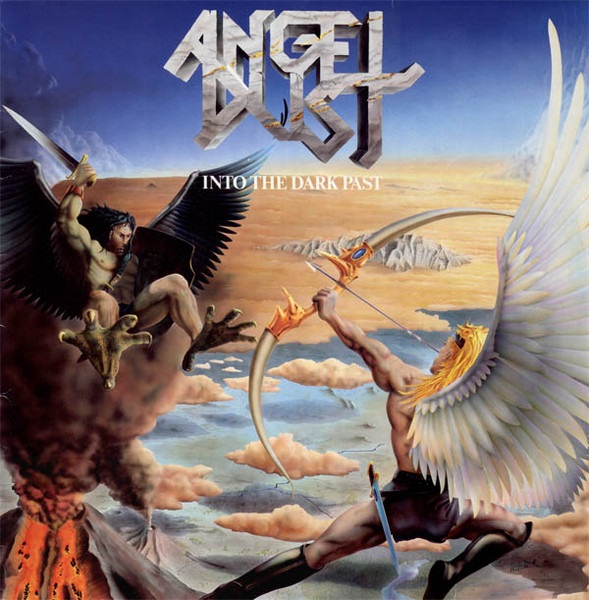
Back in the day, Cronos called it "Angel Dust" — meaning cocaine. This stuff can finish you off; the more you want it, the more it consumes you. You cry, you scream, you crawl the streets. It sends your mind soaring to the highest heights... One of the bands most influenced by this was the German group Angel Dust, who even took their name from the song.
During the ‘80s, German Thrash Metal was soaring with bands like Sodom, Kreator, Destruction, Tankard, Assassin, Vectom, Exumer, Iron Angel, and others. At the same time, groups like Running Wild, Helloween, Rage, and Grave Digger shook the European Speed Metal scene from another front. Angel Dust played a significant role in shaping the qualities of the genre. Their debut album, Into the Dark Past, perfectly embodies speed, skill, and energy—what more could you ask for? It’s one of the masterpieces fitting the Speed/Thrash metal label.
Tracklist:
Into the Dark Past
I’ll Come Back
Legions of Destruction
Gambler
Fighter’s Return
Atomic Roar
Victims of Madness
Marching for Revenge
However, beware: you cannot judge Angel Dust solely by this album. The band never fully carved their name into the Thrash metal scene because their subsequent releases gradually shifted towards Speed and, eventually, Power Metal—which I’m personally not a big fan of. This album marks their most intense Thrash Metal phase. Also, there was a 9-year hiatus after their second album in 1998.
On the debut, vocals and guitar duties were handled by Romme Keymer, second guitar by Andreas Lorum, bass by Frank Banx, and drums by Dirk Assmuth. Dirk remains the only core member today. Although Frank was with the band in the early years alongside Dirk, he left after Of Human Bondage (2002).
Back to the album: speed, speed, and more speed! The songs are fast from start to finish, with minor breaks of slower parts that don’t overshadow the overall velocity. It delivers the flavor of Speed Metal, then hands over to Thrash metal’s aggressiveness and ferocity, sprinkling in touches of classic Thrash Metal. Their later albums lean more towards this definition, but Into the Dark Past stands as an important example of old-school Speed Metal.
Regarding sound, don’t overlook the production: you can easily hear the atmospheric influence of early Agent Steel, Slayer, and Bay Area bands. Compared to many metal albums of the era, its production is impressively strong.
The intro, Into The Dark Past, is almost 1.5 minutes of piano work. As it fades, I’ll Come Back bursts in with furious, wild riffs. The opening riff is truly notable, followed by aggressive drumming and vocals that create great synergy. This galloping track features Keymer’s “When I’m back” scream, backed by relentless bass and drums. The extended, intense solo section never breaks the tempo, perfectly capturing the album’s essence. Angel Dust’s only notable difference is that the vocals are not very harsh—they’re rather plain, which keeps them from fully fitting the Thrash metal mold.
These German kids hit harder and faster riffs than the Bay Area bands, with crazy drums and unforgettable melodic parts. Legions of Destruction smells even more of Thrash than the opener, lasting over 5 minutes of chaos. It starts with a beautiful bass intro and drums, then melodic guitars burst in, bringing a hint of Iron Maiden vibes. After a minute-long intro, typical Thrash vocals roar in. Approaching the fourth minute, dueling solos elevate the music further—a pure Speed metal assault.
The longest track, Gambler, begins with a riff that makes me say, “Enough already, this is unbelievably good!” The addition of vocals enriches the flavor even more. The highlight is the rapid technical riff just before the first minute ends. Following the usual speedy pace, the song boasts over a minute of back-to-back solos starting at the third minute. After the fifth minute, it revisits the opening riff, culminating in another expansive solo. Gambler is definitely the most memorable track of the album.
Fighter’s Return crushes with aggression, reminiscent of early Slayer recordings, featuring angry solos and high-pitched screams, making it a fitting tribute to its title. Atomic Roar is another riff-and-solo assault, opening like I’ll Come Back, highlighting the essence of ‘80s Thrash/Speed. Near the end of the second minute, an unusual tempo change surprises—but it’s brief, giving way to a relentless solo display by the third minute.
Victims of Madness contrasts with the rest, featuring simple three-note riffs and catchy melodies, supported by choir vocals and a sound that screams pure Speed Metal. Finally, Marching for Revenge closes the album with solid riffs and steady tempo, ending with a cannon fire effect.
This album stands as a masterpiece not only for German Speed Metal but for Speed Metal in general. Their seemingly endless energy would make you think they could play this nonstop for months. With high-speed riffs, flashy solos, varied melodies and vocals, and otherworldly drumming, the blend of Speed, Thrash, and Heavy Metal delivers exactly what speed and skill lovers crave. A must-have for any serious collection.