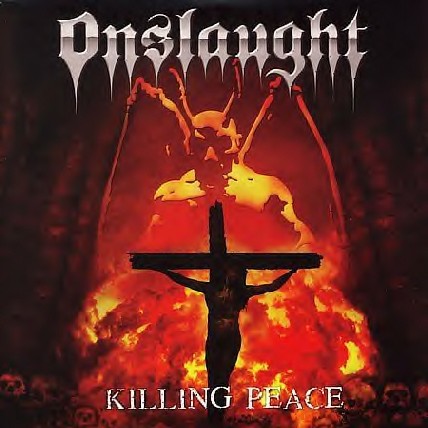
I don’t know about you, but I never imagined that the legendary Thrash Metal band Onslaught would return to making music. Especially considering how many reunions of ’90s bands have ended in disappointment, I never would have expected Onslaught to come back swinging with an album like Killing Peace—a record that hits you so hard, you’re left wondering, “Did I just get beat up?” In short, Killing Peace turned out to be a jaw-dropping masterpiece. And no, I’m not exaggerating. Let me explain why…
To give some background: British band Onslaught broke up in 1991 after their 1989 album In Search of Sanity failed to meet long-term commercial expectations. Before that, they had already released two cult albums: Power From Hell and The Force. In 2005, the band decided to regroup—revamping their lineup in the process—and spent the following years playing live shows before Killing Peace officially dropped in 2007 via Candlelight Records. The album consists of 9 tracks and runs about 44 minutes—just long enough to leave you satisfied, though a few more minutes wouldn’t have hurt.
The album was recorded and produced by Andy Sneap (of Sabbat fame), a highly respected name in the UK Thrash Metal scene. His involvement—while perhaps open to debate—often suggests a certain level of quality, and Killing Peace absolutely benefits from Sneap’s production wizardry. But more on that later. First, let’s talk about the band lineup.
The vocalist on this album is Sy Keeler, who had previously handled vocals on The Force. So this isn’t exactly a “new” vocalist, more of a triumphant return. Founding members Nige Rockett (guitar) and Steve Grice (drums) are still in place, while Alan Jordan joined on second guitar and James Hinder on bass. (Note: this was the recording lineup—there were a few post-2008 personnel changes worth noting.)
The most important point about Killing Peace is that it is 100% Thrash Metal. However, some clarification is needed. Longtime fans will likely agree that Onslaught’s earlier material falls under what we now call “old-school Thrash.” This album, though, marks a bit of a departure in terms of sound, not spirit. Thanks to Andy Sneap’s production, the album sounds extremely clean—every instrument, every note is crystal clear. The tone choices serve both the genre’s essence and modern listening standards remarkably well. That clarity might make some think the album sounds too modern, but the band is clearly not stuck in 1991. They’ve evolved—grown sharper and stronger. And to answer the inevitable question: “Then how is it still 100% Thrash?” The answer is simple: Attitude and Spirit. These are things no modern production can erase.
There isn’t a single weak song on this album. That’s not hyperbole—it’s genuinely hard to single out one track above the rest. The riffs are memorable, the lyrics are razor-sharp, and the instrumentation is tight. There’s not a single “overdone” moment or a “this part could’ve used more” section. The solos are tasteful, the pacing flawless. Not once during the 44-minute runtime will you feel fatigued or bored.
There are just a few smaller points worth mentioning. Although the album moves at a breakneck speed, well-timed tempo drops are woven into some tracks, providing essential breathing room. You’ll also hear a few well-placed vocal and guitar effects—clearly added for flavor, and they work beautifully.
It’s honestly difficult to critique this album negatively. At most, some listeners might wish the production were a bit more raw, but even then, they’ll likely admit that this level of polish suits these songs. Listen from the opener “Burn” to the closing track “Shock ’N’ Awe,” and you’ll see exactly what I mean. That’s my personal guarantee.
So, now it should be clear why I called this album a “masterpiece.” If you’re into Thrash Metal—or Extreme Metal in general—you need to hear this. Killing Peace is nothing less than a modern classic. An absolute must-listen of the 2000s.