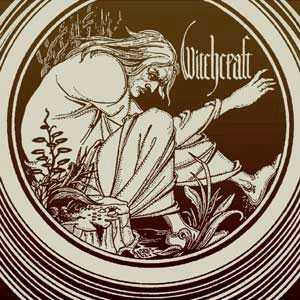
First, let’s clarify that the Witchcraft in question here is the Swedish one—those rugged young men dabbling in classic occult heavy metal. I wanted to make that clear since there are quite a few bands named Witchcraft out there.
Now, let’s get to the real subject. Witchcraft is the kind of band that makes my blood rush even before I hear a note. Just a glance at their artwork, their influences, and what’s written about them—or better yet, what they say—tells me everything I need to know. Originally, Witchcraft began as a tribute band with the intent to release a single track dedicated to Bobby Liebling of Pentagram and Roky Erickson of 13th Floor Elevators, then call it quits. That was their entire purpose. Naturally, a band that sets out to pay homage to two genuine madmen like Liebling and Erickson instantly had my full attention. Formed in 2000, Witchcraft has since released three full-length albums, two EPs, and two splits. Now, here are my thoughts. I won’t go into track-by-track detail, but I’ll give you a broad overview.
Witchcraft is easily one of the most original stoner/doom bands you’ll ever come across. They truly do justice to authentic 1970s doom. Sure, Saint Vitus is still standing, and we have Trouble, Pagan Altar, and others—bands I love and deeply vibe with. But in my opinion, Witchcraft goes a step beyond. They might be one of the truest interpretations of the phrase “influenced by Black Sabbath.” Why? Because everything about them screams '70s. If someone handed me this record and told me, “This was recorded in '73 in some smoky basement,” I’d believe it without hesitation. We all would. Because this album was recorded with vintage equipment, and you feel that raw, dusty energy from every guitar, vocal, and drum hit. Musically as well, they align more with Sabbath and especially Pentagram than the other doom giants I mentioned earlier.
Think Hendrix, early Deep Purple—that slightly distorted, fuzzy ‘70s vocal tone. The riffs are simple yet mesmerizing, not overly heavy (though back in the '70s, they would’ve been shocking), drenched in Sabbath/Pentagram/Blue Cheer influence. Add trippy psychedelic guitar effects that appear throughout, and you’ve got a dark, heavy bluesy atmosphere. Magnus Pelander’s vocals—which sound more like Ozzy in style than tone—deliver a depressive, troubled aura. Combined with the Iommi-esque yet Pentagram-leaning guitar work, the whole album feels like a slow, acid-drenched descent into darkness. Tracks like “Witchcraft,” the closing “Her Sisters They Were Weak,” “It’s So Easy,” and especially the hypnotic “What I Am” are standout moments, but the entire record is tight and consistent. There’s also a Stone Bunny (Pentagram) cover of “Please Don’t Forget Me” included.
Some might say, “Why listen to this when the originals exist?” But that’s not a fair judgment unless you’ve heard them. Witchcraft is more original than many doom/stoner bands today. Musically and sonically, they don’t follow the Saint Vitus blueprint, but rather stick to the Black Sabbath and Pentagram playbook—playing true ‘70s doom/stoner rock. Their songs aren’t long or tedious, but dark and psychedelic takes on classic hard rock/heavy metal forms. And since I mentioned Roky Erickson, it’s worth noting that 13th Floor Elevators’ drug-fueled, hallucinatory vibes and Coven’s satanic occult-rock aura are also present throughout.
In short, this is a flawless recording from a flawless band. If you want to relive the spirit of 1970s occult rock and metal—with authentic vintage sound—Witchcraft is exactly what you’re looking for.